
By Henk Jan Nix, General Secretary, EGARA
As the European vehicle recycling sector prepares for the final publication of the new Vehicle Regulation, I believe our attention must now turn from the wording of the text to its practical impact. For authorised treatment facilities, the key questions will be how the Regulation is interpreted, how responsibilities are divided, and how quickly new obligations and rights will become reality.
In this article, I will focus on several issues that are likely to be important for our sector: Extended Producer Responsibility, EV batteries, insurance, total-loss vehicles and recycling targets. While the Regulation may soon be final, many of the most important discussions for the industry are only just beginning.
The final text of the new Vehicle Regulation was completed on 20 June 2025. No further substantive amendments are expected. The text is now undergoing legal and linguistic review to correct any remaining errors before publication, which is expected in July or August.
For vehicle recyclers, however, publication of the final text will not be the end of the discussion. In many ways, it will mark the beginning of a new phase. The sector will need clarity on what the Regulation means in practice, how responsibilities will be divided, and how quickly new obligations and rights will take effect.
Key questions for authorised treatment facilities and the wider ELV chain include:
- What will Extended Producer Responsibility mean in practice?
- Which mandatory but unprofitable activities will be compensated?
- Where does the Battery Regulation take over from the Vehicle Regulation?
- Who is responsible for the safe transport, storage and treatment of electric end-of-life vehicles?
- How will ATFs secure appropriate liability insurance?
- Who is ultimately responsible for achieving the 95% reuse and recycling target?
Extended Producer Responsibility
One of the most important elements is Extended Producer Responsibility, or EPR. In principle, EPR should mean that mandatory activities which are not economically viable are compensated.
In the latest version of the text, spare parts are mentioned alongside components. From the dismantler’s perspective, this initially raised concerns. However, the intention appears to be that compensation will be assessed by waste stream, comparing costs and revenues. This would mean that compensation is not intended to cover a situation in which an ATF as a whole is no longer profitable.
The practical effect of the compensation system will only become clear once it is implemented. What is important is that parts reuse should not negatively affect compensation for unprofitable material separation activities carried out by ATFs.
Insurability of ATFs
Another major issue in many countries is the difficulty ATFs face in obtaining liability insurance. In some cases, insurance is refused by the same companies that sell, allocate or auction end-of-life vehicles, including electric end-of-life vehicles, to ATFs.
If OEMs are required to establish a proper collection and treatment network, then the insurability of ATFs may need to be considered part of EPR. This is an important point. ATFs deliver sustainable and circular services. It is difficult to accept that companies presenting themselves as “green” can exclude such essential circular activities from insurance cover.
Batteries and the boundary between Regulations
Electric end-of-life vehicles and hybrid ELVs contain large lithium-ion batteries. The technical challenges are significant, but the legal framework is also complex.
There is a risk that responsibility for the costs of battery removal, storage and collection could be disputed between different parties, leaving the ATF caught in the middle.
The basic principle should be clear. If the battery is still in the end-of-life vehicle, the Vehicle Regulation applies. The Vehicle Regulation requires the battery to be removed, stored correctly and collected. Once the battery has been removed from the vehicle, the Battery Regulation applies. From that point, EPR under the Battery Regulation should ensure that the costs of storage and collection are compensated by the battery producer.
Total-loss electric vehicles
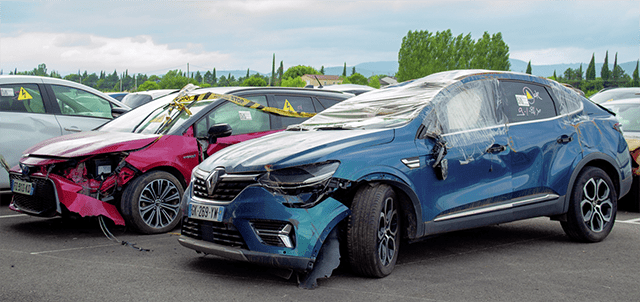
Accident-damaged electric vehicles raise further questions. If an electric vehicle is declared a total loss and becomes an electric end-of-life vehicle, it should go to an ATF. But who is responsible for transporting it there?
If an ATF buys the vehicle at auction, is the ATF then responsible for the condition of the battery, even if it has not inspected the vehicle or received a State of Health document? What happens if an incident occurs during transport or storage?
Where an electric end-of-life vehicle is assigned and transported directly to an ATF, responsibility would appear to rest with the last owner, which may often be the insurance company. In other cases, the issue is likely to depend on how the collection network is organised and how EPR is applied.
This will not be solved with a single simple answer. OEMs, producer responsibility organisations, insurers, transport companies, ATFs, authorities and emergency services may all have a role and a view. With so many stakeholders involved, practical solutions will require careful discussion.

The 95% recycling target
Some readers may interpret the text as making ATFs responsible for achieving the 95% reuse and recycling target. That would be too narrow a reading.
Achieving 95% is a chain responsibility. It starts with OEMs, who must design and produce vehicles that are recyclable in the first place. It also involves dismantlers, shredders and other operators in the treatment chain. It is worth noting that the text sometimes uses the term ATF in a broader way, including shredders. The responsibility should therefore not be placed on dismantlers alone.
Different perspectives, further debate
These examples show how the same legal text can be read differently depending on the reader’s position in the chain. The Regulation may be relatively readable, but it remains a legal text. Ultimately, it will need to be interpreted from the perspective of lawyers, the European Commission and, where necessary, the courts.
Only time, practical implementation and possibly legal cases will show how the Regulation is received by the different stakeholders.
EGARA will continue to follow the issue closely and will inform its members as questions and challenges arise.

Recent Comments